11.11 // Walls and Welcome
Monday Night Football is in full force at our house.
Tonight’s premier match-up: the Detroit Lions (with an incredible comeback from Barry Sanders) versus the Daddy Cough Drops.
Even though Sanders got roughed up quite a bit by Daddy— thrown into pillow defenders and a giant Elmo— he led his team to victory. The Cough Drops didn’t really stand a chance.
Oh, and there was a halftime concert by Olivia, bunny, and Elsa bear, too, belting out John Mayer’s infamous “Changing.” Another breathtaking performance.

Today ends loudly, but sweetly, too.
I start the examen with gratitude:
- the smell of freshly baked bread and the beloved recipe from Cameron Moore
- John Taylor’s steady breathing in his swing
- the noise of everyone doing what they love
The last point grants me pause.
There is a load a truth there, and it may be the sacred thread that knits all the God-moments from today together.
(I’ve found that this has been the richest part of examen for me: asking everywhere I’ve seen God and then wondering, How do these all connect? What is the Spirit trying to tell me through all of these different moments and voices and events? What I share here is typically what I come up with by bedtime.)
One of my greatest fears as a parent is that one of my children (of heaven forbid, all of my children) will feel unloved at home. I fear that they will interpret my love or discipline or human weakness as disapproval; as rejection of their truest selves; a condemnation that they are “too much” and need to hold back or silence their hearts; that their pain is not welcome; that their differences are faults.
This can cause anxiety in my mama-heart because the reality is that I love, love, love my kids! With each one I feel like heart grows at least two sizes! (Its snowing outside so a Grinch reference is, in fact, appropriate.)
And because I love them so, the thought of them leaving home one day without really believing that they belong here— to me, to our family, to this world— well, that is devastating.
I know this kind of reaction is possible because I’ve seen it play out around me. While I felt very loved as a child, I know many who interpreted their parents’ love as conditional or tempered or obligatory. Sometimes, that was the case. Other times, and probably most times, we realize that those beliefs about one’s mother or father’s judgement or disapproval are created because children misinterpret love— they see imperfect love as lack of love.
And I know I give imperfect love.
My human heart cannot give my kids that constant, complete love they crave. And I fear that weakness, as natural as it is, may hurt them. And I know many, many mothers feel this same way.
Raising children can be as heavy as it is joyful.
I think that is why tonight was such a gift. Seeing Olivia sweetly sing and Benson run around with a helmet and Jackson roast his green coffee beans and John Taylor swing and squawk— everyone is welcome right here. And to see such freedom with my hands deep in sticky, wet bread dough— it blesses me.
In the snow, I look out across the parking lot and see the church bright white.
I know all too well a similar struggle over there.
Our love can be rooted in the fullness of God.
Our love can also be weak.
And at other times, our love can grow as ice cold as the snow, becoming something else altogether— silent, fearful, and exclusive.
An author I really respect and follow shared this heartbreaking post yesterday:
“We left our last church because it was doing nothing to address the sins of white supremacy both in the church itself and in the white American church as a whole.
So we left, after 2 years of trying to fight for them to see it.
Yes, that is enough of a reason to leave.
If you want to stay, ask yourself why you stay.
If you need to leave, name the reason and let go. Its okay.
I’ve bee a church leader in one way or another since I was 12. People stay because they’re scared to to see what’s outside those walls.
God is outside those walls.”
And these thoughts have weighed heavy on me because, in many respects, I know they are true.
They are heavy because it is so often preached that God is held by some powerful elite in brink and mortar walls.
They are heavy because I have chosen to remain a part the church and so feel the responsibility to do the hard work she is talking about—- to lay out the welcome mat, to actively listen.
They are heavy because the church is God’s family, His very body— and we need everyone; we need every part. As one who believes in the sacredness of the church and how essential the community of believers is to our formation in God, my heart grieves.
And at the same time, as I look out at our church building again, I know she is right: God is outside those walls.
But the truth that God is outside the walls does not negate the gathering of His people.
Instead, they point to our very need to gather so we can see God everywhere.
In yesterday’s post I reflected on the words of Aaron Neiquist. He is another author but has chosen to stay inside the church. But he declares the same truth: “We don’t come to church to find God. We come to church to learn to find God everywhere.”
Those who gather within the walls admit this truth:
We don’t hold God hostage here as a commodity, as sign of any kind of prestige, as some possession.
We come to learn to find God everywhere.
And in every place.
And through every one.
And among us, too.
And if we come into buildings and sacred spaces to learn to find God everywhere, we must be willing to learn how to see Him in all people and in all kinds of people and in all expressions of personhood.
And so His body needs every part, every person.
We are all welcome inside so we can find God outside.
This morning, Olivia and I were coloring at the kitchen table over toast and coffee. And as I sorted through the coloring pages, I noticed one of the pictures she colored earlier in the week. It was a picture of Jesus healing Jairus’ daughter. Jesus is lifting the young girl by the hand as her parents look on at the miracle before them.
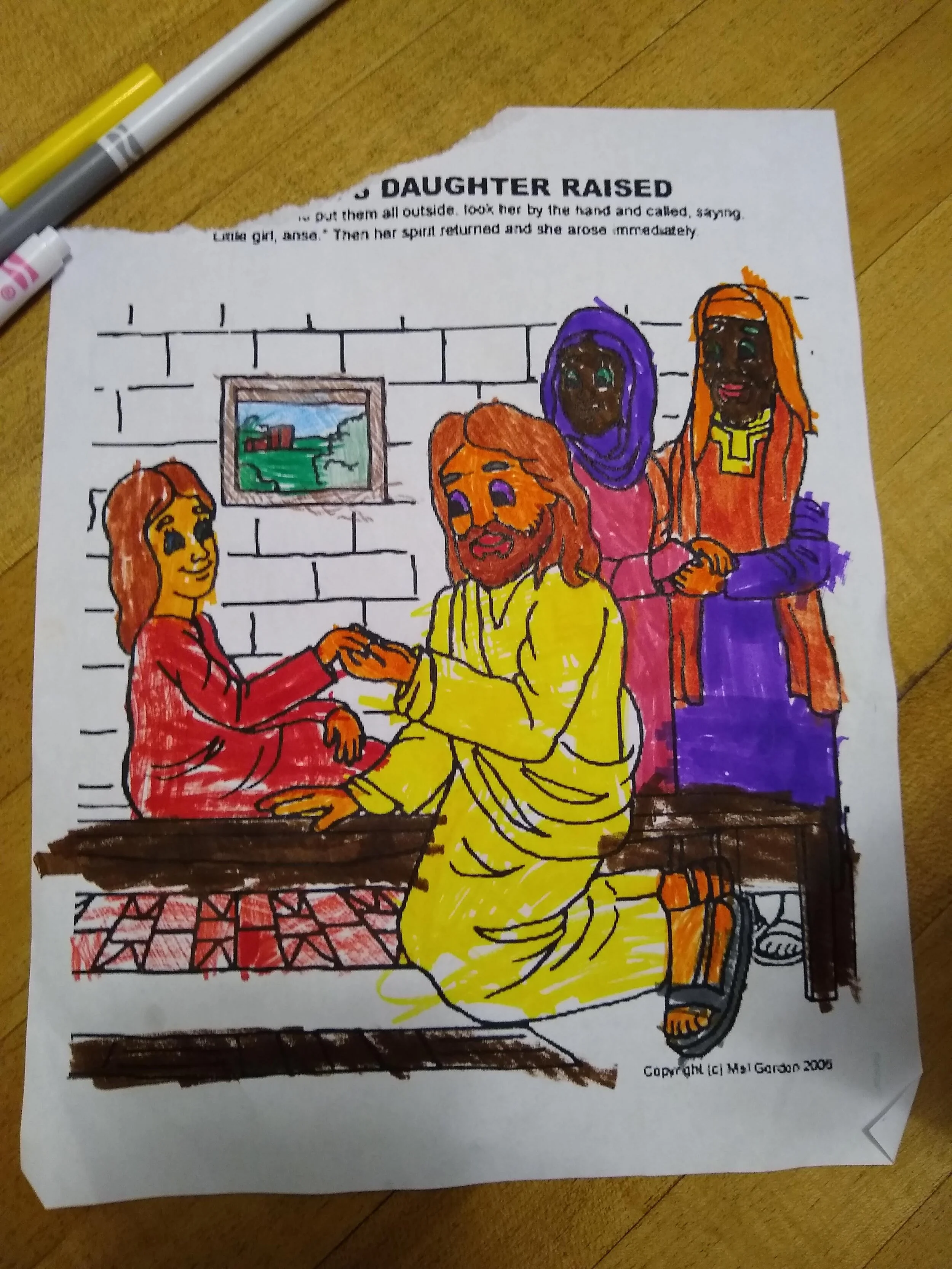
What I noticed about Olivia’s depiction of this story was how she chose to color the skin of Jesus and Jairus’ family: Jesus and the girl have dark orange skin, and her parents are colored with a brown marker. I decided to color the same picture, and when it was time to choose a marker for the people, I asked her what color I should choose. Olivia gave me some choices and replied, “You know everyone has different skin, mom. And everyone is part of the story.”
Everyone is part of the story.
I tried to color Jesus’ feet and Jairus’ beard and the little girl’s nose while being mindful of that glorious truth: that everyone belongs in this Gospel miracle. We are all being taken by the hand and resurrected.
I wish I could say that I have had many incredible conversations about race relationships and gender equality and diversity with Olivia— that I helped create a culturally “woke” five year old.
But, honestly, we have probably not had enough conversations about the value of diversity in our town and country and church.
The only thing I can contribute her beautiful revelation to is living with Jesus— living simply in a Love that overflows and abounds and includes and never, ever turns away.
Living with Jesus grants us a purity of heart to see that everyone is part of the story.
Somewhere along the way, we learn exclusion. We learn power and its ability to discount others as powerless. We learn how to elevate those like us and degrade other’s differences. It is as Nelson Mandela said, “No one is born hating another person because of the color of his skin, or his background, or his religion. People must learn to hate…”
And if I have learned nothing else in our political and cultural climate, it is is that the Empire (to use Walter Brueggemann’s term) of hate is hinged on learned fear: fear that there is not enough.
If we refuse to acknowledge the Empire of power and fear and then deem it as sinful, we create determiners of who is in an who is out. Our own participation in this evil perverts communities into hierarchies, families into exclusive country clubs, and distorts Love into something that stratifies rather than unifies.
And so to protect itself against scarcity, the Empire preaches that the power to heal is kept within walls.
In the quiet of our kitchen, Olivia echoes the words of Jesus and opposes the Empire and rings true the Good News again: Everyone is part of the story. Everyone belongs.
There is no scarcity. There is more than enough.
There is life to the full, life abundant for all who believe.
Maybe this is one of the meanings behind Jesus’ statement on being “born again” or that the Kingdom is for the “least of these”— for children. We have to return to a faith of pure, boundless love. We have to neglect the belief that the Kingdom is some sort of pie: to invite more to the table means that we all get less.
Kids seem to understand this much more readily.
We adults are conditioned to possess and capitalize.
And to be afraid.
But, again, this is not the childlike, Kingdom way.
Yes, the Kingdom is always countercultural: a mustard seed, hidden, among and within you.
The Kingdom is always multicultural: including the Canannite women, the Samaritan, a Jewish temple patron named Jairus, the bloodied and dying thief, and now all of us. Every single one of us.
The Kingdom always sides with the humble, the powerless, the lowly, those who receive Jesus’ steady invitation to raise up from the dead.
And when we take His hand, we become part of the movement of the Kingdom: a revolution to overthrow the Empire in all of its forms: death, exclusion, hate, fear.
In this family of God, we are all welcome.
We are welcome to be who we are, who we are made to be.
There is room for all of us at the table.
For all of us who heed the words “Talitha koum!” and breathe.
Little girl— old man, tired women, fearful son— I say to you, get up!